FOR IMMEDIATE RELEASE
February 26, 2026
CONTACT
Logan Elizabeth Padgett
(850) 386-3131
lpadgett@jamesmadison.org
The James Madison Institute Releases Latest JMI Poll of Florida Voters
What Floridians Want from Tallahassee on Affordability, Taxes, Education, and Growth
TALLAHASSEE – Today, The James Madison Institute released the latest installment of the JMI Poll, a comprehensive survey of 1,200 registered Florida voters, offering a revealing look at voter priorities and preferences across key policy and political issues including taxes, education choice, economic pressures, and the 2026 elections.
Key Findings
Florida voters are feeling the affordability crunch, and they want Tallahassee to act. Housing affordability is being driven, in voters’ minds, by “fixed” costs such as insurance and taxes, not just by supply. A majority of respondents point to insurance and property taxes as key drivers of housing costs and are broadly open to property tax reform.
A strong majority of poll respondents also say the country is highly divided, and only about half feel safe sharing their political views. This hesitancy underscores the challenges facing public trust and the sense of unity within communities. Even with polarization high, there are areas of broad agreement in local issues such as property tax reform and energy reliability.
While voters express concern about division in the nation, they affirm the Constitution’s relevance and favor balanced historical education as the U.S. nears its semi-quincentennial.
There is robust backing for flexibility in education, such as access to public school a la carte courses by students in private or homeschools and an easing of regulations for new schools, alongside strong endorsement of cursive writing instruction.
In the gubernatorial race, among likely voters, Republican Byron Donalds leads Democrat David Jolly by 5 points, consistent with recent polling trends, though undecided voters remain significant.
“With America approaching its 250th anniversary, Floridians are demonstrating that patriotism and pragmatism go hand in hand. They overwhelmingly affirm the Constitution’s enduring importance, yet they are clear-eyed about the economic challenges facing their families. As the State of the Union conversation highlights national resilience, our findings show voters want that resilience reflected in policies that rein in property taxes, strengthen energy reliability, and expand educational opportunity across Florida.” — Dr. Bob McClure, President and CEO, The James Madison Institute
“Even in a time when more than seven in ten voters say the country feels deeply divided, Floridians are finding common ground on key issues. From property tax reform to energy reliability and education choice, there is a broad appetite for solutions that reinforce constitutional principles while addressing real economic pressures. Florida has an opportunity to lead with policies that strengthen not only our state, but the nation.” — Logan Elizabeth Padgett, The James Madison Institute
A closer look at the full results provides additional context behind these key findings and offers deeper insights. Below is a detailed breakdown of the survey data across major issue areas.
Economic and Affordability Concerns
The survey finds that cost of living remains a central concern for Florida voters.
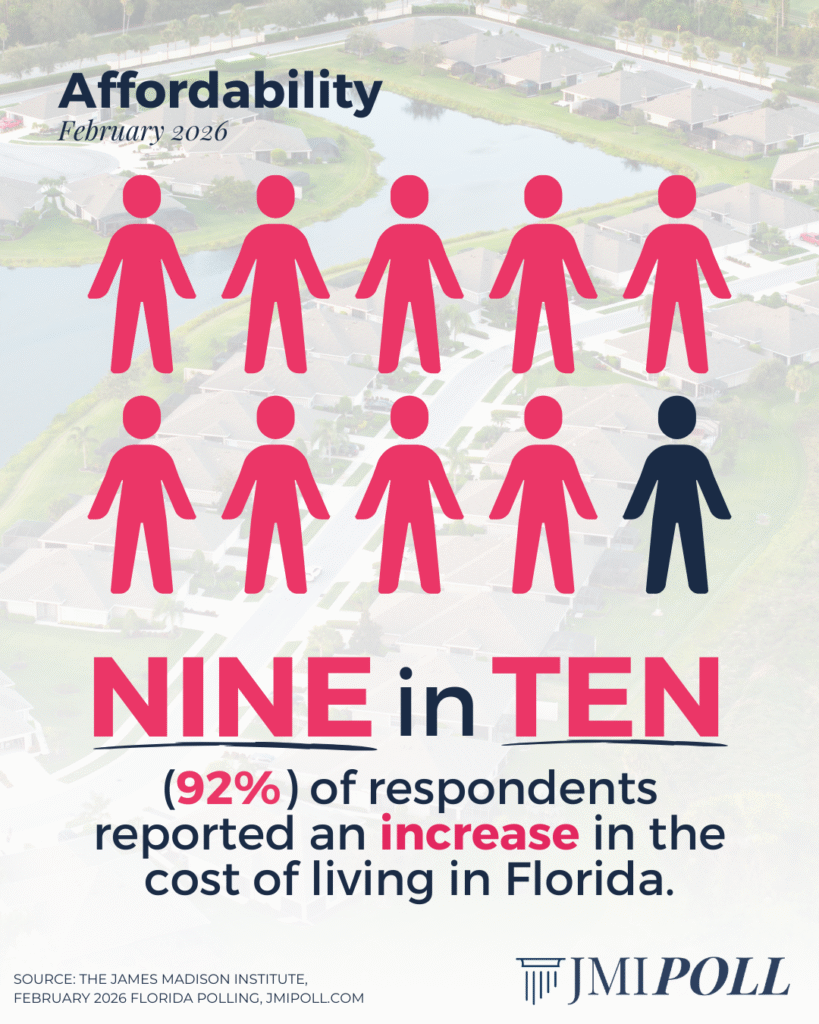
Cost of living is the dominant pressure point: A substantial 92% of respondents reported increases in living costs. Four percent reported no change, 3% noted decreases, and 1% were unsure. This widespread perception underscores the pervasive impact of inflation on daily life. While the rate of inflation growth has slowed, voters still want to see a reset of the cost of living in the state and country.
Insurance and taxes top the blame list for housing costs: When asked about the factors contributing to housing affordability challenges, respondents cite insurance (24%), taxes (22%), and housing supply (19%) most frequently. Smaller shares cite state (6%) and local (5%) building regulations. Fifteen percent are unsure.

Property taxes feel like they’re rising for most homeowners: Over half (54%) reported paying more in property taxes, while 19% saw no change and 3% paid less. Twenty-one percent of registered voters do not pay property taxes, and 3% were unsure. This trend underscores growing fiscal burdens for homeowners. The generational divide is stark. Floridians 65 and older are the most likely to say they’re paying more in property taxes (61%) and are the strongest supporters of complete elimination (33%). Younger voters aged 18-34, meanwhile, are the most comfortable with the status quo at 11%, double the rate of older cohorts, likely because many are renters who don’t feel the property tax burden directly.
Property tax reform is a consensus issue: There’s a strong consensus for change in property taxes, with 42% favoring moderate reforms and 35% supporting complete elimination (totaling 77% of respondents in favor of reform). Only 7% prefer the status quo and 17% are unsure, indicating a broad appetite for restructuring property taxes in the state.
These insights portray an electorate grappling with economic strains, particularly in housing and taxes, and receptive to reforms that curb excesses without overhauling systems entirely.
2026 Gubernatorial Election
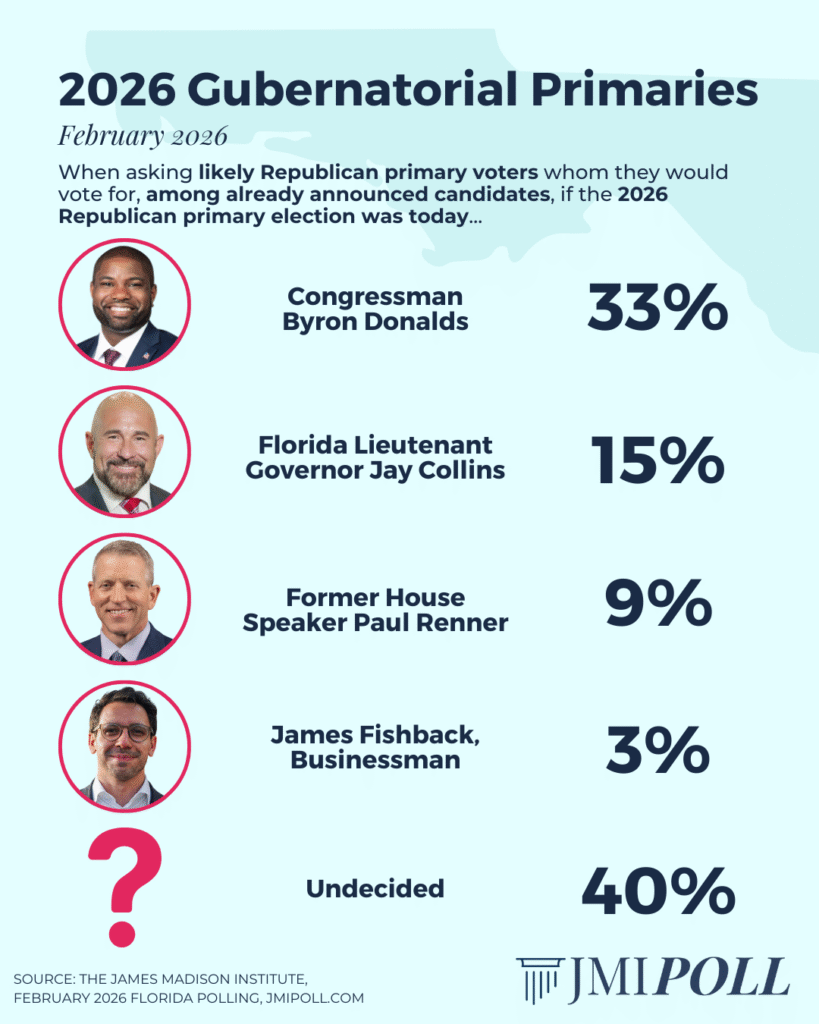
Republican Byron Donalds is maintaining a lead in the gubernatorial race, bolstered by support from President Trump. In the Republican primary (among likely Republican voters): Byron Donalds holds 33%, Jay Collins 15%, Paul Renner 9%, James Fishback 3%, and 40% undecided.
President Trump’s influence is notable. When Floridians are polled about which candidate the President likely endorsed, only 29% believe he endorsed Donalds and 48% are unaware. Sixty three percent say an endorsement would make them more likely to support a candidate (36% much more, 27% somewhat), with 28% unaffected and 4% less likely.
This polling landscape portrays Donalds as the current frontrunner, with Trump’s endorsement serving as a significant booster once voters know about the nod from the President. Undecided segments offer room for campaign shifts, particularly as primaries approach.
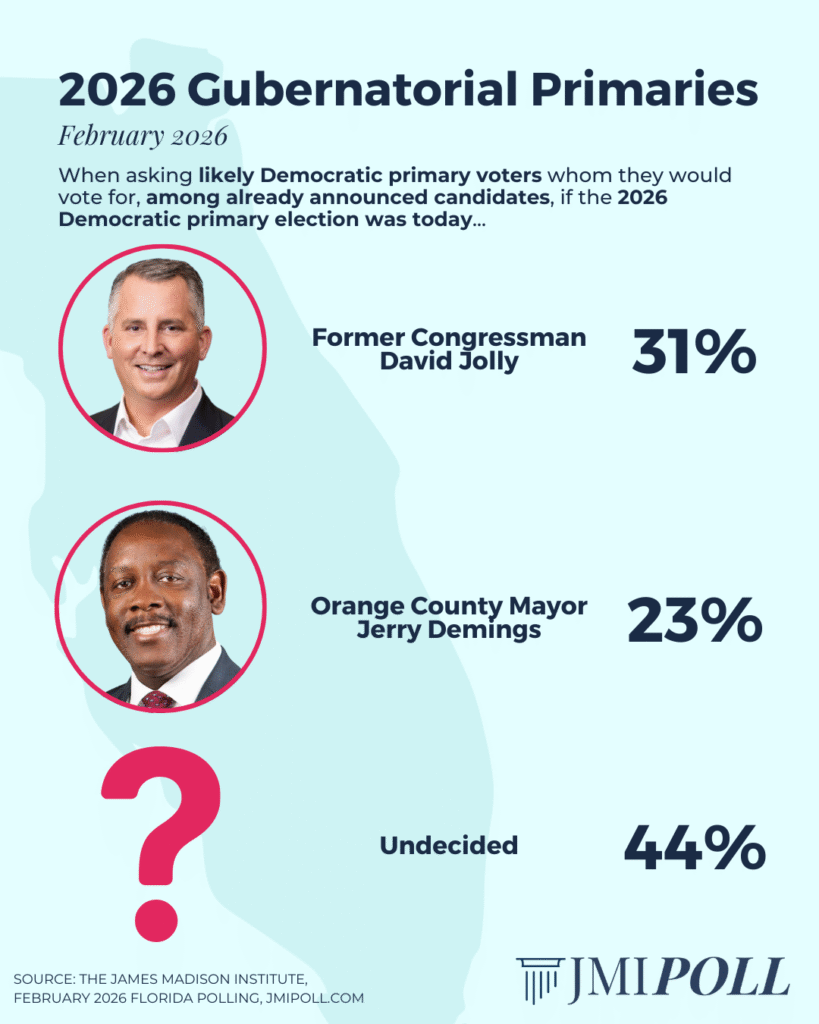
In a matchup for the Democratic nomination for governor, former Congressman David Jolly received 31% support, Orange County Mayor Jerry Demings 23%, 2% indicated they would not vote, and 44% were unsure.
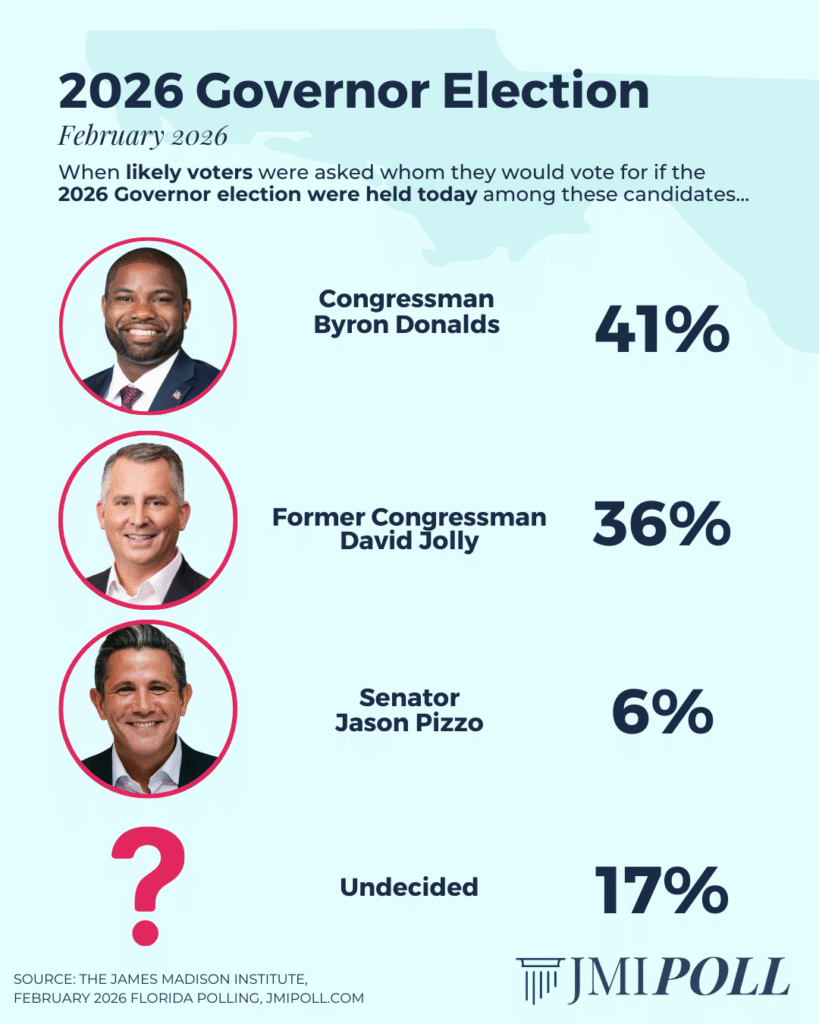
Among likely voters (those very or somewhat likely to participate), when asked about the general election, Donalds garners 41%, Jolly 36%, Pizzo 6%, and 17% undecided/other, yielding a +5 margin for Donalds.
Political Climate and National Perspectives
Florida voters perceive profound national divisions yet maintain faith in foundational principles.
A strong majority of respondents say the country is divided: Seventy-one percent see the country as extremely or very divided, 21% somewhat, and just 6% not divided, with 2% unsure. This sentiment frames a backdrop of societal tension.
Many voters self-censor politically: A slim majority (52%) feel safe sharing political views (18% very, 34% somewhat), but 44% feel unsafe, and 4% are unsure. This divide suggests caution in public discourse, potentially affecting voters’ views on division in the country.
“Strong Union, troubled economy” resonates: Fifty-nine percent agree with the statement “the state of our Union is strong, but our economy is troubled,” versus 36% disagreeing, and 4% unsure. This captures optimism tempered by economic worries, particularly around the affordability issue.
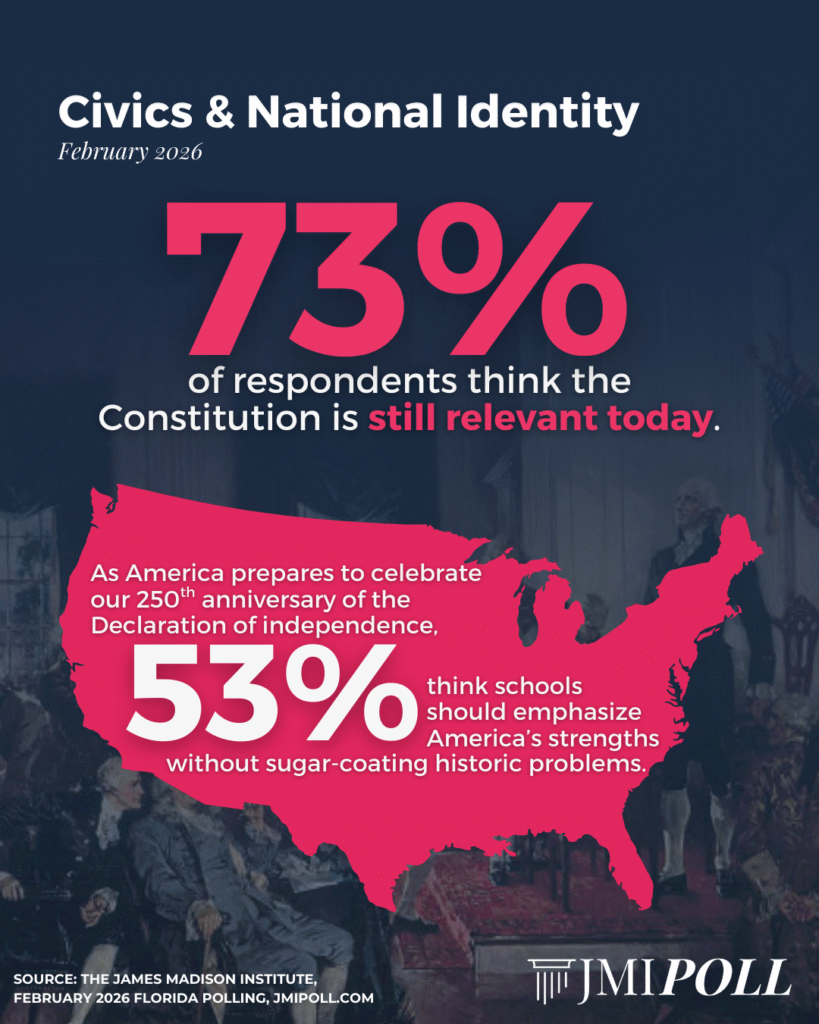
The Constitution retains broad support: Seventy-three percent affirm its ongoing importance, compared to 23% who doubt it, with 5% unsure. That drops to just 40% among 18-34 year olds, with 26% of younger voters saying it probably or definitely isn’t relevant at all.
Voters want balanced civics education for America’s 250th: Fifty-three percent prefer emphasizing strengths without sugar-coating problems, 19% prefer acknowledging flaws without ignoring successes, 14% desire an exclusive focus on strengths, 8% on failures, and 6% unsure. This balanced approach aligns with patriotic yet critical education.
Voter ID is widely seen as confidence-building: Seventy-six percent agree voter identification would boost election confidence for federal elections, with 16% disagreeing, and 8% unsure. Strong support indicates a priority on electoral integrity.
These responses depict a polarized yet principled voter base, emphasizing unity through core American ideals while addressing contemporary divisions.
Technology, Energy, and Health Issues
Voters show enthusiasm for infrastructure growth but wariness toward certain technologies, reflecting a pragmatic stance on progress.
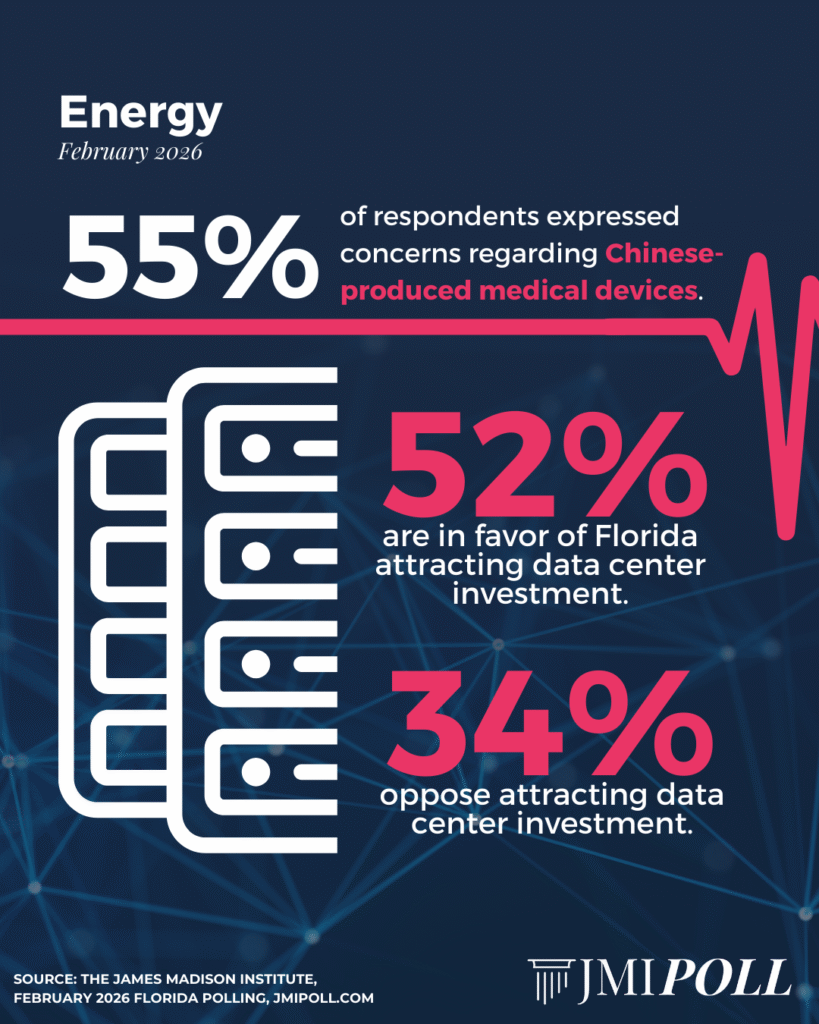
Concern is elevated about Chinese-produced medical devices: Fifty-five percent are concerned, 40% are not, and 5% are unsure.
Voters strongly back expanding energy power generation: Seventy-two percent support expansion to meet demand, 14% oppose, and 14% are unsure. With Florida’s growing population, this endorsement underscores the urgency of reliable energy.
Data centers draw majority support, but with clear hesitation: Fifty-two percent favor steps to draw investment, 34% oppose, and 14% are unsure. Balancing economic benefits with environmental and ratepayer concerns appears key.
Autonomous vehicles face a trust deficit: Only 32% view autonomous vehicles (like Waymo) as safe, while 60% see them as unsafe, and 7% unsure. Survey data show that younger generations are more likely than older generations to view autonomous vehicles as safe, with higher percentages of adults under 45 rating them “very” or “somewhat” safe compared to those 65 and older.
These findings suggest voters prioritize practical advancements while demanding safeguards, providing a roadmap for technology policy.
Education and Family Preferences
Strong support for both innovative and traditional educational options for students indicates a desire for adaptable systems that meet the state’s growing and diverse needs. In a world where cost isn’t a factor, voters lean toward private options, suggesting “choice” is as much aspirational as ideological.
Voters favor “unbundling” public education options: Sixty-two percent support offering individual courses for a fee, 25% oppose, and 13% unsure. This flexibility could aid homeschooling families.
There’s support for putting unused school space to work: Fifty-five percent favor renting to private educators, 32% oppose, and 13% unsure. Utilizing idle resources appeals to voters.
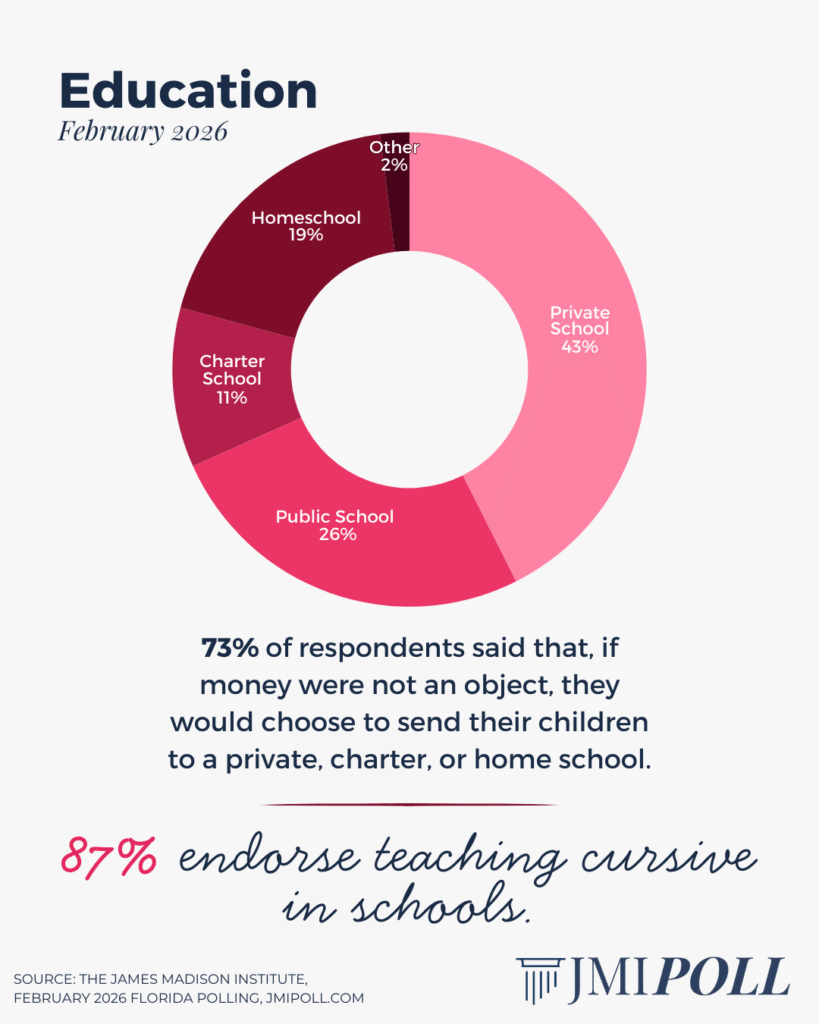
If cost weren’t a barrier, private school is the top choice: Forty-three percent prefer private schools, 26% public, 19% homeschooling, 11% charter, and 2% other. Voters desire education choices beyond their current options.
Voters want fewer barriers to launching new schools: Sixty-eight percent support lifting barriers, 18% oppose, and 14% unsure. Demand for expanded choices drives this sentiment.
AI in classrooms is viewed more positively than negatively: Fifty-four percent consider its use positive, 40% negative, and 6% unsure. Younger Floridians (18-44) are significantly more positive about AI in education (60-62%) compared to the 65+ cohort, which is essentially split at 49% positive.
Teaching students how to use AI safely has majority support: Sixty-two percent support instruction on safe use, 32% oppose, and 7% unsure. Voters are more open to AI than the public debate might imply, especially when framed around teaching students to use it safely.
Cursive is overwhelmingly popular: Eighty-seven percent endorse teaching cursive writing, 8% oppose, and 5% unsure. On classroom culture, voters are signaling a ‘back to basics’ preference—high standards and traditional skills still resonate.
Demographic and Lifestyle Insights
Florida’s population remains highly migratory: Thirty-nine percent of registered voters are first-generation, 18% second, 16% third, 6% fourth, 4% fifth, and 17% unsure, illustrating Florida’s migratory character.
Religious attendance varies widely: Twenty-seven percent attend weekly, 11% a few times monthly, 15% yearly, and 46% rarely or never (23% each), with 1% unsure.
Find the polling website at jmipoll.com.
You can read the full poll with party and regional crosstabs here.
You can read the full poll with demographic crosstabs here.
You can read the full poll of registered voters here.
###
The James Madison Institute is a 501(c)3 organization dedicated to the ideals of limited government, economic freedom, federalism and individual liberty coupled with individual responsibility. The institute conducts research on such issues as criminal justice, health care, taxes and regulatory environments.