
FOR IMMEDIATE RELEASE
August 6, 2026
New Poll: Florida Voters Back Property Tax Relief, Health Care Price Transparency, and School Choice — While Wary of Data Centers
74% of voters support the proposed homestead property tax amendment; Byron Donalds and David Jolly lead their respective primary fields, with Donalds and Jay Collins each holding narrow leads over Jolly in general-election matchups
TALLAHASSEE, Fla. — A new statewide survey of Florida registered voters conducted on behalf of The James Madison Institute finds broad, bipartisan support for property tax relief, health care price transparency, and expanded education options, alongside deep voter skepticism about data center development in their communities.
The survey of 1,400 Florida registered voters was conducted July 20–26, 2026, by Targoz Market Research. The margin of error is +/- 2.62%.
“Cost of living is the issue on every Floridian’s mind right now, and the new JMI Poll shows just how deeply it is shaping their views,” said Dr. Robert McClure, President and CEO of The James Madison Institute. “Nearly all voters, regardless of party affiliation, say prices are going up, and they support meaningful relief — from cutting property taxes to demanding price transparency in health care. Policymakers should take note.”
Property Taxes: Broad, Bipartisan Support for Homestead Relief

Nearly three-quarters of voters (74%) support the Legislature’s proposal to significantly reduce or eliminate property taxes on homesteaded residences, including 44% who strongly support it. Just 17% oppose the idea. Support crosses party lines, with 89% of Republicans, 64% of independents, and 59% of Democrats backing the proposal. When presented with tradeoffs, 55% of all voters say the cuts are worth it even if local governments have to cut spending or find other revenue.
Voters are split on the scope of reform: 46% prefer relief focused on homesteaded residences, while 38% favor a broader approach covering rental, commercial, and second-home properties. Younger voters and Black voters lean toward the broader approach, while voters 65 and older strongly favor homestead-focused relief. Two-thirds (67%) of voters own their home; among renters, 38% hope to purchase a home in the next 24 months.
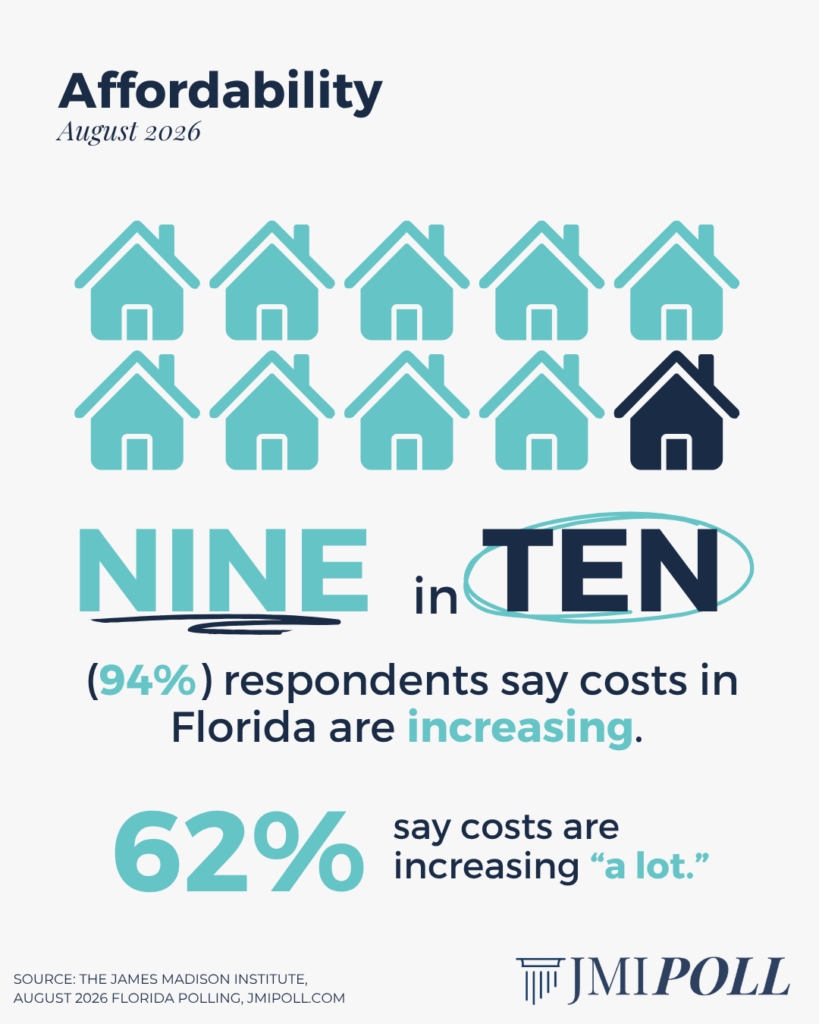
Underscoring the urgency of the issue, 94% of voters say the cost of living in Florida has increased over the past year, with 62% saying costs are rising “a lot.”
The Race for Governor
On the Republican side, Congressman Byron Donalds leads the primary field with 49% support among likely primary voters, followed by Lt. Gov. Jay Collins (18%) and former House Speaker Paul Renner (8%).
Former Congressman David Jolly leads the Democratic primary with 47% among likely primary voters; no other candidate tops 5%.


In hypothetical general-election matchups among likely voters, Donalds leads Jolly 45% to 38%, and Collins leads Jolly 44% to 39% — with roughly one in six voters still undecided in each matchup.
Health Care Price Transparency
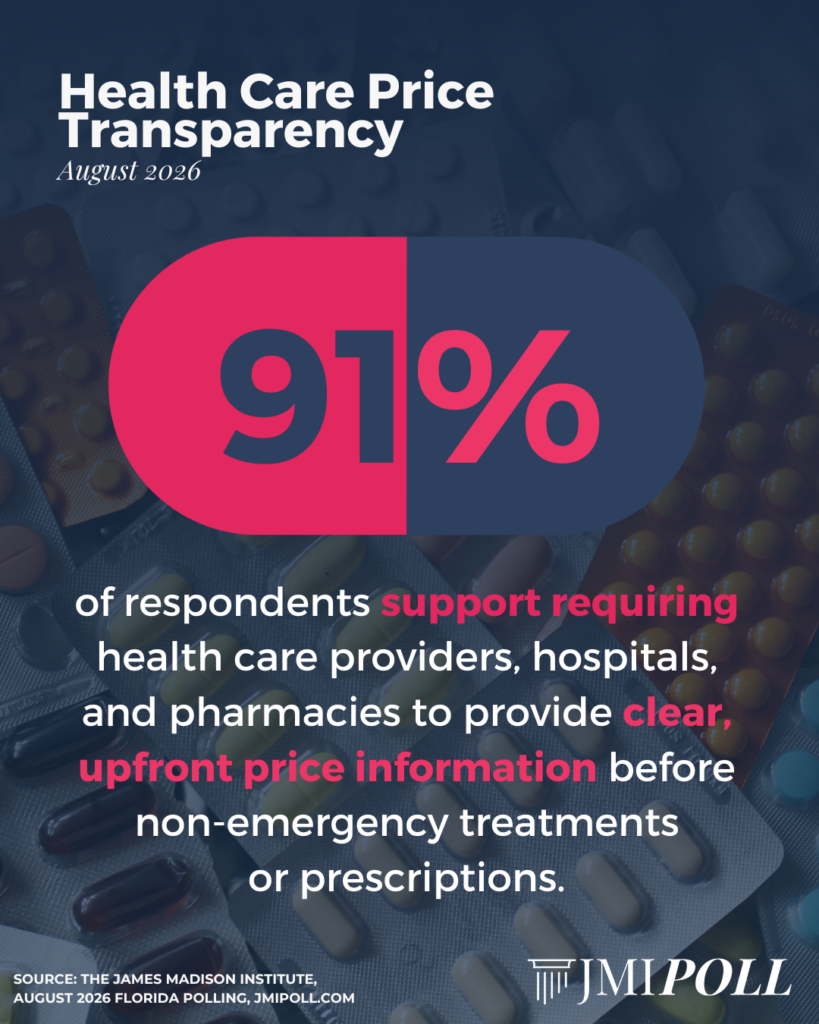
An overwhelming 91% of voters support requiring health care providers, hospitals, and pharmacies to disclose clear, upfront pricing before non-emergency treatment or prescriptions are provided — support that holds steady across party lines (91% of Republicans, 88% of Democrats, 92% of independents). Nearly two-thirds of voters (65%) say their own treatment decisions would change if they knew prices in advance.
AI Adoption Grows, But Data Centers Face Local Resistance

Most Florida voters are now familiar with artificial intelligence: 79% say they’ve heard at least “some” about AI, and 55% report using an AI chatbot in the past six months.
Despite that familiarity, voters oppose state efforts to attract data center investment, 49% to 40%, and would rather see their own county commission reject a proposed data center than approve one (48% to 30%). Opposition spans every partisan group and most regions of the state, driven chiefly by concerns over higher electricity costs (60%) and increased local water usage (44%).
Education: Strong Appetite for Choice and New Models
Florida voters show wide support for expanding education options, including:
- 85% support for additional college-credit options for high schoolers beyond AP courses
- 77% support for converting underused malls or retail space into K-12 learning centers
- 66% support for larger school choice scholarships for students in low-income neighborhoods
- 64% support for public schools offering individual courses to part-time students

Redistricting and the Nation’s 250th
Nearly two-thirds of voters (64%) are aware that Florida redrew its congressional districts ahead of the 2026 elections, though views of the new maps are split along party lines and largely unlikely to move turnout, with 51% saying the new lines have no effect on their intent to vote.
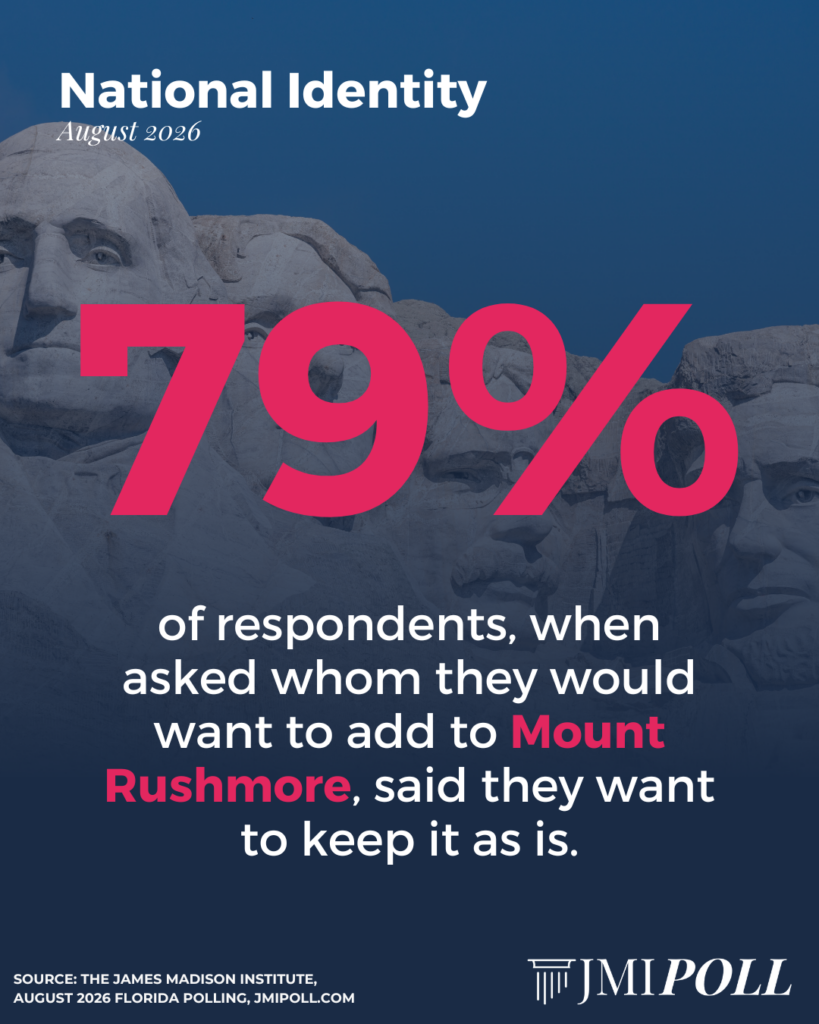
As the nation marks the 250th anniversary of the Declaration of Independence, 62% of Florida voters say they are hopeful about America’s future. When asked who should be added to Mount Rushmore, 79% answered no one.